
Can Punctuation Save Money?
Nobody notices when it's right. But when it's wrong, the costs of getting punctuation wrong can be explosive.
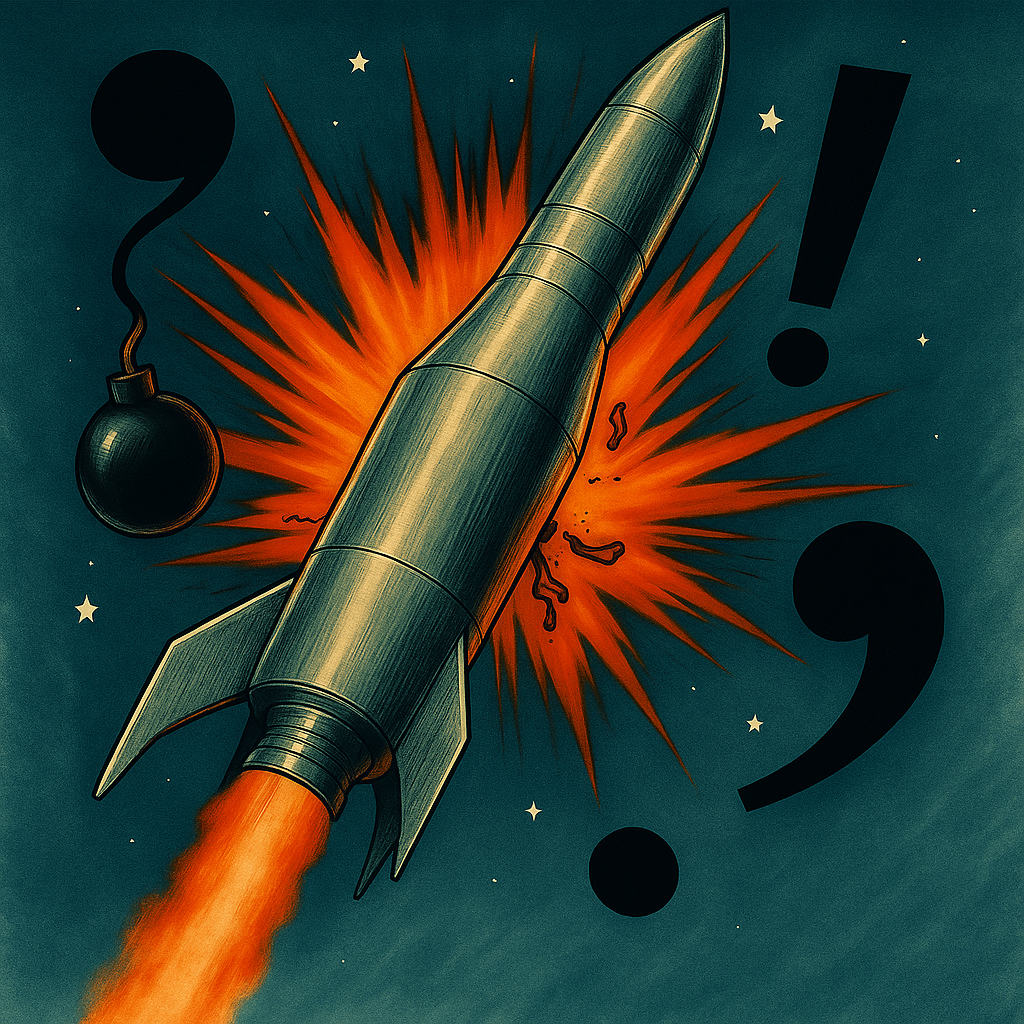
Whether it's a contract clause, a line of code or a missing mark on a legal document, punctuation errors can cost eye-watering sums of money. Here are some real-world examples that show why those tiny marks really matter.
The commas that cost millions
In 2006, a legal dispute between Rogers Communications and Aliant Telecom in Canada showed the extent of the damage one tiny, missing comma can do. Their disagreement centred on a comma that muddied a contract clause about how and when the agreement could be terminated. The comma made the clause ambiguous: Rogers believed it guaranteed a five-year minimum term, but Aliant argued that it allowed termination at any time with one year's notice. In the end, the regulator agreed with Bell Aliant's interpretation and, basing its judgment on the rules of punctuation, allowed them to terminate the contract early, costing Rogers an estimated $1 million.
Across the border in 2017, a group of US dairy drivers argued that they were entitled to overtime pay, but the company they worked for claimed that their duties were excluded from overtime entitlement under state law. The problem? The law should have included an Oxford comma, but it didn't, which changed the specification of what the drivers' duties actually were. The court in the O'Connor v. Oakhurst Dairy case ruled in favour of the dairy drivers – and they walked away with a multi-million-dollar payout.
The hyphen that blew up a rocket
In 1962, NASA had to destroy its Mariner 1 space probe just minutes after launch, all because of a missing hyphen*. The tiny omission in the guidance code caused the Mariner 1's rocket to veer off course, and it had to be commanded to self-destruct... at a cost of around $18 million.
*Okay, it was, as NASA likes to emphasise, not a hyphen but an overbar for the symbol R for radius (R instead of R̅) in an equation. However, it still shows that even the smallest punctuation mistake can have a huge impact.
Why punctuation matters in translation
In translation, a misplaced punctuation mark probably won't take out a spacecraft, but it can derail meaning, confuse details and quietly undermine trust in your brand.
In Dutch-to-English translation, you can't just move the Dutch punctuation straight over to the English text either, because the rules are different, especially for commas, colons and semi-colons.
The danger in not knowing how to punctuate correctly is that even small punctuation changes can shift the meaning of a sentence. Note the difference between 'Let's eat, Grandma!' and 'Let's eat Grandma'. In business writing, poor punctuation can cause shifts in tone that subtly affect how your copy comes over to the audience. Take these examples:
Thanks, as always.
Thanks as always.
Thanks. As always.
Same words, slightly different feel. One is warm. One is neutral. One is a bit frosty.
Punctuation affects the clarity, rhythm and tone of your message, even though your audience might not realise it. If you're investing in a translation, commas should not be an afterthought. A good translator will understand what you want to communicate and know how to use punctuation correctly, ensuring that nothing is lost in translation.
And yes, nuanced punctuation is one of the things machine translation still struggles to do well.
Want to ensure poor punctuation won't hit you in your pocket?
Whether you need to have your Dutch text translated into English, a final proofread of an English text or something in between, I can help. Get in touch to discuss how I can make sure your punctuation (and everything else! ) is perfectly on point.